Motion in a Static Magnetic Field - Processing of Perceived Magnetic Field Measurements
Premise
In 2008, the then ISPESL promoted a research project (in which, in addition to ISPESL, operational units of IFAC and ENEA participated) to further investigate the assessment of exposure to EMF of operators working in magnetic resonance imaging (MRI) departments. The project had mainly dosimetric objectives, to achieve which it was necessary to develop a method for acquiring the waveform of the magnetic field perceived as variable over time by an operator moving in the magnetostatic field. This waveform is also fundamental for the determination of the radiometric quantities foreseen by the specific ICNIRP guideline of 2014, relating to the prevention of the effects resulting from such movement, i.e. the maximum variation ΔB over 3 seconds and the weighted peak indices referred to the limits for the stimulation effects.
This method subsequently evolved into the proposal of a possible standard approach to the problem of evaluating occupational exposure due to the movement of an operator in any non-homogeneous magnetostatic field. This approach is based on a Narda-Metrolab THM-1176 probe, worn by the operator himself or by a volunteer who simulates his behaviour. The probe must be fixed to a point on the subject's body, as shown in the figures. As a fixing point, the head is often chosen, due to the importance of this organ in relation to the effects of the exposure studied: in this case, the internal frame of a cycling helmet can be used, as shown in the figure. The probe is then connected to a personal computer using a sufficiently long USB extension cable. The probe management software supplied as standard by the manufacturer is run on the personal computer.
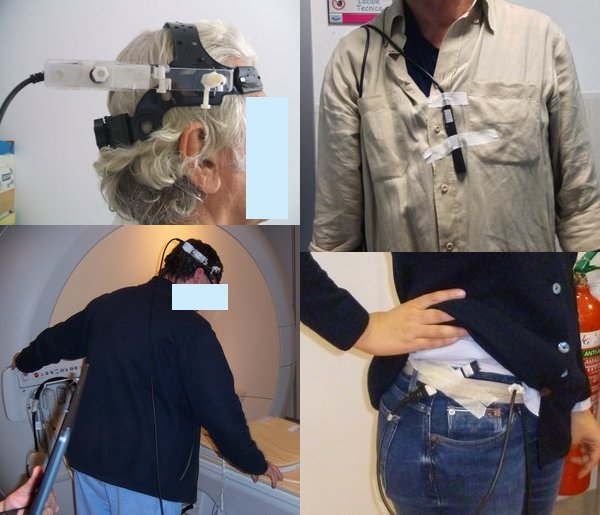
The subject is then asked to perform the typical movements of the various activities carried out in relation to the task studied, in areas where an intense static magnetic field is present; during these movements, the instantaneous values of the magnetic induction vector detected by the probe are stored in a file on the personal computer.
The web tool to which this information sheet refers was created to allow the processing of these data files, using them directly in the native format generated by the measurement probe mentioned and its standard management software.
Purpose
This tool allows the processing of the
magnetic field that varies very slowly over time measurements,
to obtain the radiation protection parameters provided for
by the ICNIRP-2014 Guidelines Guidelines for
limiting exposure to electric fields induced by movement
of the human body in a static magnetic field and by
time-varying magnetic fields below 1 Hz
: in particular,
the maximum variation ΔB in any interval
of 3 seconds and the index weighted peak for
stimulation effects.
The instrument is particularly useful for assessing the exposure suffered by an individual who moves in an environment where there is an intense non-homogeneous static magnetic field (such as in magnetic resonance departments): the movements of the exposed subject give rise to a magnetic field perceived by the subject as slowly varying over time. For this purpose, the measurement sensor must be fixed on a part of the subject's body (for example the head), so that it participates in a supportive manner in his movements.
Important note
The limits proposed by the cited ICNIRP-2014
Guidelines do not have binding value, since these
Guidelines have not been integrated into any legally relevant national or
community document. However, compliance
with these limits - also recommended by the Non-binding guide to
good practice for the implementation of Directive 2013/35/EU
on electromagnetic fields
- has a recognized
scientific basis.
General approach
The instrument is designed to process the data files
produced by the Narda-Metrolab
THM1176 Hall effect magnetometer (connected to a personal computer
through its native USB interface) and is able to automatically
recognize and manage three different formats of these files, adopted by the
manufacturer in three different phases of the probe's life: the two
historical ones and the current EZMag3D software export (see at the
bottom of this sheet).
The data files in question are made up of
vector samples of magnetic induction acquired at
sufficiently close successive instants of time.
The data file generated by the THM1176 magnetometer is sent to the WebNir server, where it is decoded and processed to calculate the relevant radiation protection parameters and build the graphs shown among the results.
Limitations
- The THM1176 magnetometer, at least the tested specimens, was able to save on PC reliably and continuously a flow of measurements with a maximum speed of 10 vector samples per second. This limits the maximum frequency of the perceived magnetic field spectrum reconstructed by the instrument to 5 Hz.
- To avoid unacceptably long processing times,
the calculation of the maximum ΔB variation over 3 seconds
is performed only if the product of the sampling
frequency and the number of samples is less than
one million; otherwise the value
N/A
is shown.
Input data file format
The input data format is the one provided by the
Narda-Metrolab magnetometer THM1176.
This, depending on the installed firmware, can
save the measured data in the following formats.
First version
12,317243 10,265700 6,797100 -0,359600 MT 20634 0x0000000000060315
12,320505 10,301500 6,753200 -0,261200 MT 20614 0x000000000006031f
12,358934 10,318400 6,794500 -0,329600 MT 20620 0x0000000000060329
12,319015 10,285600 6,771700 -0,329600 MT 20659 0x0000000000060333
12,322512 10,305300 6,745800 -0,373200 MT 20635 0x000000000006033d
12,339373 10,312900 6,765800 -0,358000 MT 20656 0x0000000000060347
12,308422 10,318700 6,695000 -0,445700 MT 20646 0x0000000000060351
12,299327 10,297000 6,713600 -0,415700 MT 20624 0x000000000006035b
12,295990 10,286300 6,724000 -0,413800 MT 20625 0x0000000000060364
12,293187 10,297800 6,702000 -0,401200 MT 20681 0x000000000006036e
...
Second version
Block B Bx By Bz Units Temperature Timestamp Serial No. Comment
0 0.000644 -0.000290 -0.000567 -0.000101 T 20989 2013.06.19 22:02:20.604394039 0000105
0 0.001074 -0.000590 -0.000800 -0.000406 T 20989 2013.06.19 22:02:20.704394039 0000105
0 0.000783 -0.000187 -0.000565 -0.000510 T 20989 2013.06.19 22:02:20.804394039 0000105
0 0.000745 -0.000294 -0.000457 -0.000510 T 20989 2013.06.19 22:02:20.904394039 0000105
0 0.000851 -0.000499 -0.000464 -0.000510 T 20989 2013.06.19 22:02:21.004394039 0000105
0 0.000723 -0.000301 -0.000236 -0.000613 T 20989 2013.06.19 22:02:21.104394039 0000105
0 0.000731 -0.000605 -0.000356 -0.000204 T 20989 2013.06.19 22:02:21.204394039 0000105
0 0.000706 -0.000290 -0.000567 -0.000305 T 20989 2013.06.19 22:02:21.304394039 0000105
0 0.001073 -0.000484 -0.000908 -0.000303 T 20989 2013.06.19 22:02:21.404394039 0000105
0 0.000869 -0.000605 -0.000357 -0.000511 T 20989 2013.06.19 22:02:21.504394039 0000105
1 0.000511 -0.000404 -0.000238 -0.000204 T 21005 2013.06.19 22:02:21.604394039 0000105
1 0.000615 -0.000397 -0.000459 -0.000101 T 21005 2013.06.19 22:02:21.704394039 0000105
...
Third version (EZMag3D software)
This is the manufacturer's current software export: a header
with the Source;EZMag3D signature and the measurement
unit declared in the Parameters line
(Units=mT); the data, semicolon-separated, start
after the column-header line.
Source;EZMag3D v1.2.3
Timestamp;2025.08.02T11:22:13
Description;Magnetic Field Measurement File, Metrolab Technology SA

Type;tMXR_BODY_EZMAG3D
Version;1.0
Comment;
Instrument;THM1176-MF 0002598

Parameters;Units=mT;Range=0.008;AutoRange=1;TriggerMode=Continuous;AcqRate=10;DispRate=1;Avg=100;FreqMin=0;FreqMax=5;Bins=5;BlockSize=10

Timestamp;B;B.B';Bx;By;Bz;Temp;dB
2025.08.02T11:21:14.049454055;0.0744983;-0.0525771;0.069817;0.0196624;-0.0169992;21171;0.05
2025.08.02T11:21:14.149454055;0.0710563;-0.0623716;0.0576843;0.0240541;-0.0338072;21171;0.05
...
Procedure
- Switch to the
Processing
tab. - Press the
Data File
button and select the data file containing the measurements you want to process. - Press the
Process
button and wait for the processing to complete. The computation time increases rapidly as the number of acquired time samples increases: see the following table for a rough estimate.Number of samples Expected computation time (s) 100 0.1 200 0.5 300 1 500 5 1000 15 1500 30 2000 60 3000 120 - Press the
Reset
button if you want to reset the application to proceed with a new processing.
Results
A tab with the summary data and the calculation results is displayed and two graphs are produced. The graphs are fully customizable and the related data can be downloaded both in CSV format (numeric data only) and in JSON format (numeric data and information on the graph formatting).
- The first contains five series of data, namely:
- the three Cartesian components and the modulus of the magnetic induction vector B;
- the maximum value of the modulus of the variation of B (max|ΔB|) over a moving window of 3 s.
- The second contains three series of data, namely:
- the weighted peak index referred to the reference levels
for the population (European Recommendation 1999/519/CE);
[NOTE: this index has no legal relevance, because the recommendation in question does not refer to the weighted peak method]; - the weighted peak index referred to the lower action values for workers (Legislative Decree 159/2016);
- the weighted peak index referred to the higher action values for workers (Legislative Decree 159/2016).
- the weighted peak index referred to the reference levels
for the population (European Recommendation 1999/519/CE);
Example files
The following files illustrate the functionality of the
application. To use them, save them on your computer
and reload them in the Processing
tab of this application by pressing the Data Files
button.
Keywords: Motion, Static Magnetic Field, Perceived Magnetic Field, Processing, Measurements